How Equity FDI Drives Digital Exports in Emerging Markets: A Post-2017 Shift in Capital Flows Composition

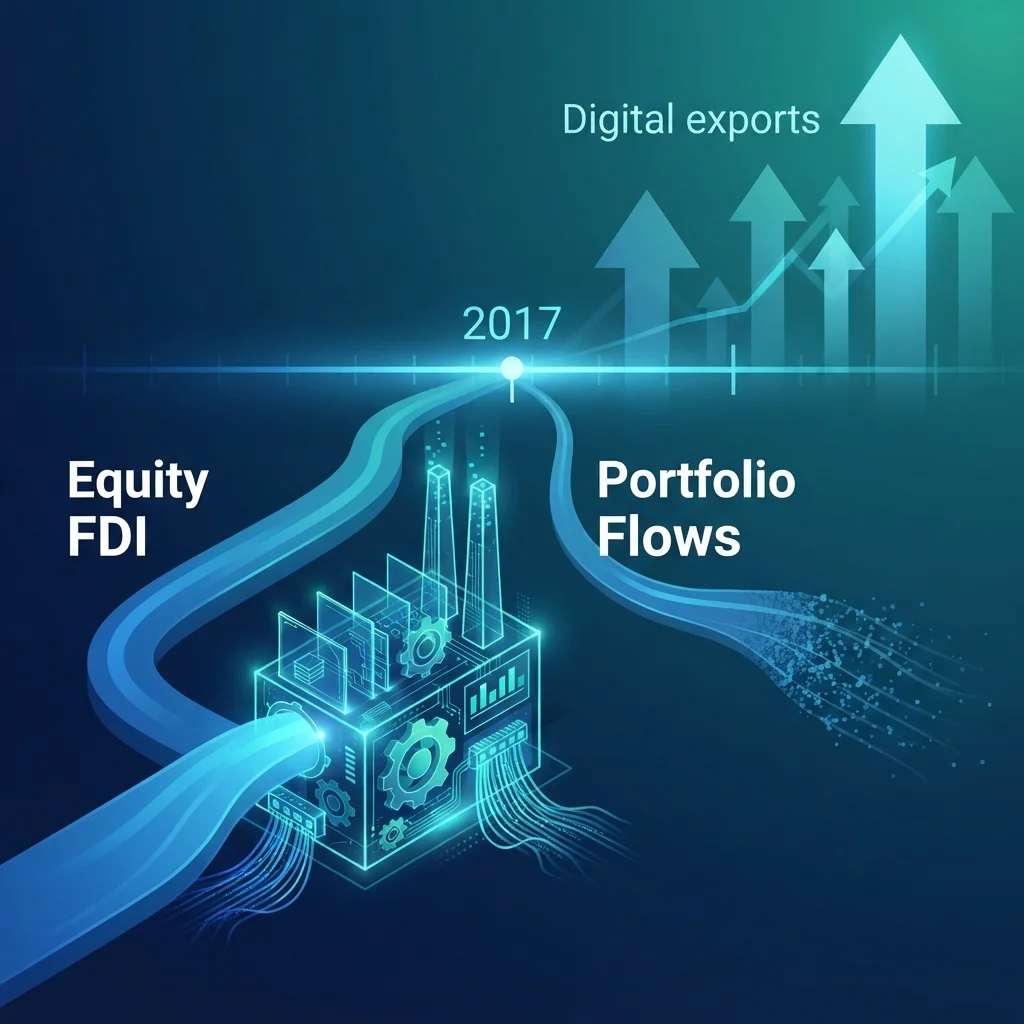
How Equity FDI Drives Digital Exports in Emerging Markets: A Post-2017 Shift in Capital Flows Composition
Introduction: The Hidden Logic of Capital Flows and Digital Trade
For years, the prevailing wisdom held that any form of foreign capital inflow would help emerging markets leapfrog into the digital age. Yet the evidence tells a more complicated story. While smartphone penetration, internet access, and digital payment systems have spread rapidly across the developing world, only a handful of countries—Vietnam, Malaysia, India, and a few others—have managed to translate this digital adoption into sustained growth of ICT goods and services exports. Most others remain stuck as net importers of digital products, despite receiving substantial foreign investment.
[IMAGE: World map with selected emerging markets highlighted, showing digital adoption versus export performance gap.]
A new study by the Institute of International Finance (IIF) offers a compelling explanation for this divergence. Authored by Marcello Estevão and Jonathan Fortun, the research draws on a balanced panel of 23 emerging market economies from 2008 to 2024 to examine how different types of capital flows affect digital export performance. Their central finding is both counterintuitive and policy-relevant: it is not the total volume of capital inflows that matters, but their composition. Specifically, equity-based foreign direct investment (equity FDI) is consistently linked to stronger exports of ICT goods and services, while portfolio flows show no systematic relationship. Crucially, this link strengthened markedly after 2017, when digital production became more capital-intensive and deeply embedded in global value chains. The analysis reveals a structural shift in the logic of digital trade finance—one that carries profound implications for policymakers, investors, and industry leaders navigating the evolving digital economy.
Equity FDI vs. Portfolio Flows: The Decisive Divide
The IIF study’s methodology is straightforward but rigorous. Using a balanced panel of emerging markets—including countries from Asia, Latin America, Central and Eastern Europe, and Africa—the authors regress annual growth in ICT goods and services exports against disaggregated capital flow components, controlling for standard macroeconomic variables such as GDP growth, exchange rate volatility, and trade openness. The results are unambiguous.
Across multiple specifications, equity FDI emerges as a robust and positive driver of digital export growth. A one-standard-deviation increase in equity FDI inflows is associated with an approximately 2.5 to 3.5 percentage point increase in ICT export growth in the following year. By contrast, portfolio equity and debt flows—whether measured as gross inflows or net—display no statistically significant relationship with digital export performance. The study’s authors are emphatic: “Equity based foreign direct investment is consistently associated with stronger digital export growth, while portfolio flows display little systematic relationship.”
[IMAGE: Bar chart comparing average digital export growth rates for countries with high equity FDI inflow vs. high portfolio inflow.]
Why does equity FDI matter so much more than portfolio flows? The answer lies in the nature of the investment. Equity FDI involves the acquisition of a lasting interest in a local enterprise, typically accompanied by management control, technology transfer, and the establishment of production facilities. When a multinational corporation builds a semiconductor assembly plant or a data center in an emerging market, it brings not only capital but also proprietary know-how, quality control systems, and access to global distribution networks. These intangible assets are critical for producing ICT goods and services that meet international standards and can be competitively exported.
Portfolio flows, in contrast, are short-term and liquid. They buy existing shares or bonds on local exchanges, often with an eye on capital gains rather than operational improvements. While portfolio investments can boost stock market liquidity and corporate financing, they rarely result in the kind of hands-on technology transfer or supply chain integration that drives digital exports. A factory owned by a foreign parent company is far more likely to export its output than a domestic firm that has simply seen its stock price rise thanks to portfolio inflows.
The study also controls for the quality of institutions, human capital, and infrastructure—factors that might independently affect digital trade. Even after accounting for these, the superiority of equity FDI holds. This suggests that the composition of capital flows is not merely a proxy for broader economic development; it has a distinct causal channel through which it shapes export outcomes.
The Post-2017 Inflection Point: Digital Production Goes Capital-Intensive
Perhaps the most striking finding in the IIF research is that the relationship between equity FDI and digital exports is not static. When the authors split their sample into two periods—2008–2016 and 2017–2024—they discover that the effect of equity FDI becomes significantly larger after 2017. The coefficient more than doubles, and the statistical confidence tightens.
[IMAGE: Line graph showing the correlation coefficient between FDI equity and digital exports over time, with a clear upward break after 2017.]
What happened around 2017 to cause this inflection? The study points to a fundamental transformation in the nature of digital production. In the early 2010s, many digital exports—especially services like call centers, data entry, and basic software development—were labor-intensive and required relatively modest capital outlays. A small office with a few computers could serve global clients. Foreign direct investment in such activities was helpful but not decisive; local entrepreneurs could bootstrap their way into digital trade.
After 2017, however, the digital economy entered a new phase characterized by capital intensity and deep integration into global value chains. The rise of cloud computing, artificial intelligence, and advanced manufacturing of ICT hardware—such as server chips, optical modules, and 5G infrastructure—demanded massive upfront investments in physical assets (data centers, fabrication plants) and intangible assets (patents, software platforms, proprietary algorithms). These assets cannot be built with short-term capital. They require patient, long-term commitment from foreign investors who are willing to transfer technology and embed local operations into global corporate networks.
Industry trends confirm this narrative. The global cloud market, dominated by Amazon Web Services, Microsoft Azure, and Google Cloud, saw explosive growth starting in 2017. Companies like Huawei and Samsung scaled up their semiconductor fabs in Vietnam and Malaysia. Similarly, the production of high-end printed circuit boards and electronic components shifted from China to Southeast Asia, attracting billions of dollars in equity FDI. Meanwhile, countries that relied heavily on portfolio inflows—such as Turkey, South Africa, and Argentina—saw minimal growth in their digital export sectors, even as their financial markets boomed.
The implication is clear: emerging markets that attracted equity FDI before 2017 built a production base that could capitalize on the subsequent capital-intensive wave. Latecomers that depended on portfolio flows found themselves unable to compete. The post-2017 shift has created a winner-take-most dynamic in digital trade.
Policy Implications: Building Digital Trade Capacity Through Long-Term Investment
For policymakers in emerging markets, the IIF study delivers a sobering message. The race to attract foreign capital should not be measured by total inflows but by the quality and composition of those flows. Short-term financial openness—removing capital controls, easing portfolio investment restrictions—may boost stock markets and improve balance-of-payments statistics, but it does little to build sustainable digital export capacity. In fact, overly liberal portfolio capital regimes can introduce volatility and undermine the long-term planning that digital manufacturing requires.
Instead, governments should prioritize policies that attract equity FDI, particularly in sectors linked to digital production. This means investing in infrastructure that matters for multinationals: reliable electricity, high-speed internet, logistics hubs, and industrial parks with customs and regulatory facilitation. It means strengthening intellectual property protection, which gives foreign investors confidence to transfer proprietary technology. And it means designing tax and incentive schemes that reward long-term commitment rather than short-term financial arbitrage.
For example, Vietnam’s success in becoming a major ICT exporter—growing from virtually zero in the early 2000s to over $100 billion in 2024—is directly attributable to its aggressive pursuit of equity FDI from Samsung, LG, and other electronics giants. The country offered special economic zones, corporate tax holidays, and stable labor laws, while keeping portfolio capital liberalization gradual. In contrast, countries like Brazil and Indonesia, which opened their capital accounts to portfolio flows earlier and more extensively, have seen slower growth in digital exports relative to GDP.
Investors, too, can draw lessons. The post-2017 landscape rewards those who make patient, operational equity investments rather than speculative portfolio bets. For asset managers, the composition of capital flows into an emerging market may serve as a leading indicator of future digital trade performance. Countries with a high share of equity FDI relative to portfolio flows are likely to become more competitive in ICT exports, offering both revenue growth for invested companies and potential for capital appreciation in the long run.
Industry leaders, particularly multinational corporations in the digital supply chain, should factor this dynamic into their location decisions. The strength of a country’s equity FDI ecosystem—measured by the presence of other foreign affiliates, the quality of supplier networks, and the depth of local R&D—can amplify the benefits of a single investment. A virtuous cycle emerges: more equity FDI attracts more FDI, creating clusters of digital manufacturing and services that are hard for portfolio-dependent rivals to replicate.
Conclusion: Rethinking Capital Flow Strategies for the Digital Era
The IIF study by Estevão and Fortun provides a rare empirical contribution to a policy debate that has long been dominated by ideology. It shows that the composition of capital flows is not a secondary issue—it is the primary determinant of whether emerging markets can build durable digital export industries. The post-2017 shift towards capital-intensive digital production has only widened the gap between countries that attract equity FDI and those that rely on portfolio flows.
For emerging markets, the path forward is clear: move beyond the false choice between financial openness and protectionism. Instead, design a selective strategy that favors long-term equity investment over short-term capital mobility. This is not about closing the door to foreign capital, but about opening the right door. The digital economy of the 21st century demands factories, data centers, and intellectual property—not just hot money. Those who understand this distinction will be the ones writing the next chapter of global digital trade.